





Key takeaways
- Most startup outages come from a few avoidable decisions, not bad luck.
- Invest in alerting before dashboards: an alert that reaches a person is what protects you.
- Test in staging, never in production, and plan a fallback for every third-party service.
- Start serverless; adopt Kubernetes only when you can name the problem it solves.
- Measure your MTTD: how fast you find out something broke, before your customers do.
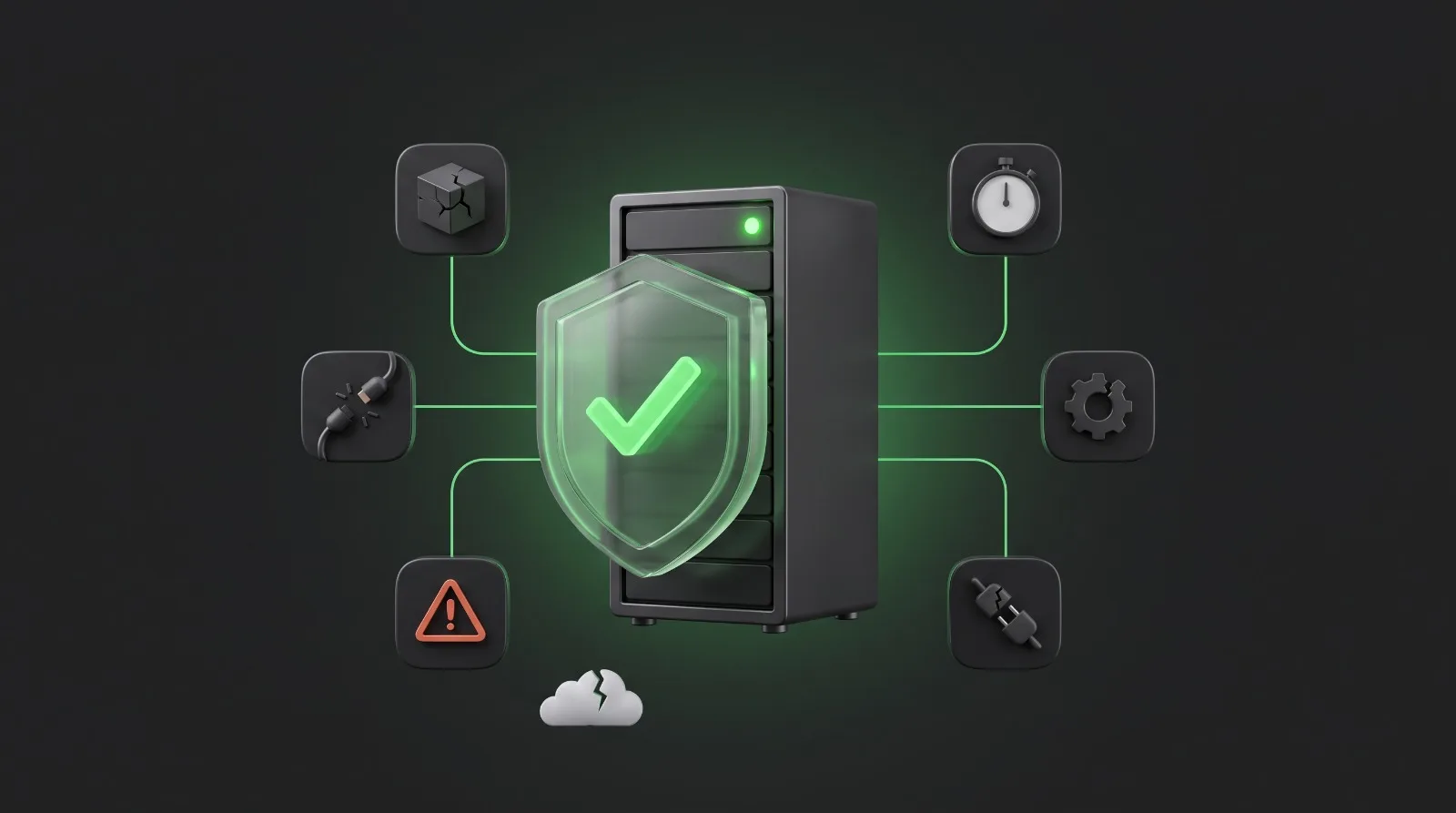
Most startup outages are not bad luck. They are self-inflicted.
Talk to any SRE who has been called in after an outage and you will hear the same story: the startup did not have a reliability problem, it had seven small decisions that added up to one big outage. The site went down in front of paying customers, the team spent a weekend firefighting, and the fix, in hindsight, was obvious.
Our SRE team sees these patterns again and again in our site reliability engineering services work with early-stage startups. The good news: every one of them is avoidable, and none of them needs a big budget to fix. Here are the seven mistakes, and what to do instead.
First, why it matters. Outages are getting more expensive, not less:
of operators said their most recent major outage cost more than $100,000
Source: Uptime Institute, 2026said their last major outage cost more than $1 million
Source: Uptime Institute, 2026median cost of one hour of a high-impact IT outage
Source: New Relic Observability Forecast, 20251. Chasing flashy, untested tech
Early-stage teams love the new thing. A new framework, a new database, a new tool that everyone is talking about, and it goes straight into production.
The problem is not the technology. The problem is that production is where you find out whether something actually works, and by then your customers are the testers. There is no Stack Overflow answer for the bug you just hit at 2 AM, no runbook, and nobody on the team has debugged it before.
Boring technology is a feature, not a failure. Pick tools that are mature, well-documented, and already running in production somewhere else. Your job is to ship a product that stays up, not to win points for using the newest stack.
2. No monitoring, no alerting: flying blind
This is the mistake our team sees most often: a startup with no end-to-end guardrail for monitoring at all. No uptime check, no error-rate alert, nothing that tells the team something is wrong.
So how do they find out the site is down? A customer messages them. Or tweets about it. That is the worst monitoring system in the world: slow, public, and already damaging trust by the time it fires.
Here is the part most startups get wrong: they think monitoring means an expensive setup. It does not. As our SRE team puts it, you do not need to invest heavily in Grafana or a big observability platform on day one. But you do need to invest in alerting. A dashboard nobody watches is decoration. An alert that wakes someone up is protection.
The data backs this up. Teams with full-stack observability report high-impact outages far less often:

3. Testing in production
If reliability matters to you, separate your environments. Development, staging, production: three different places, with testing happening anywhere except the one your customers use.
Startups skip this because it feels like overhead. "We are small, we will just push it live and see." And then a Friday deploy breaks checkout, and the whole weekend is spent fixing something a staging environment would have caught in ten minutes.
A staging environment does not need to be expensive or identical to production. It needs to be close enough that the common mistakes (a broken migration, a missing environment variable, a bad config) show up there first, not in front of customers.
4. Trusting third-party dependencies blindly
Your product is not just your code. It is your payment gateway, your email provider, your maps API, your SMS service. Your uptime is their uptime, and startups almost never plan for the day one of them goes down.
Ask yourself: what happens to your product right now if your payment provider has an outage? Does checkout fail gracefully, or does the whole page crash? Most early-stage teams have never asked the question, let alone tested the answer.
of publicly reported outages over nine years came from third-party IT and data center providers: cloud, telecom, colocation
Source: Uptime Institute, 20265. Kubernetes too early
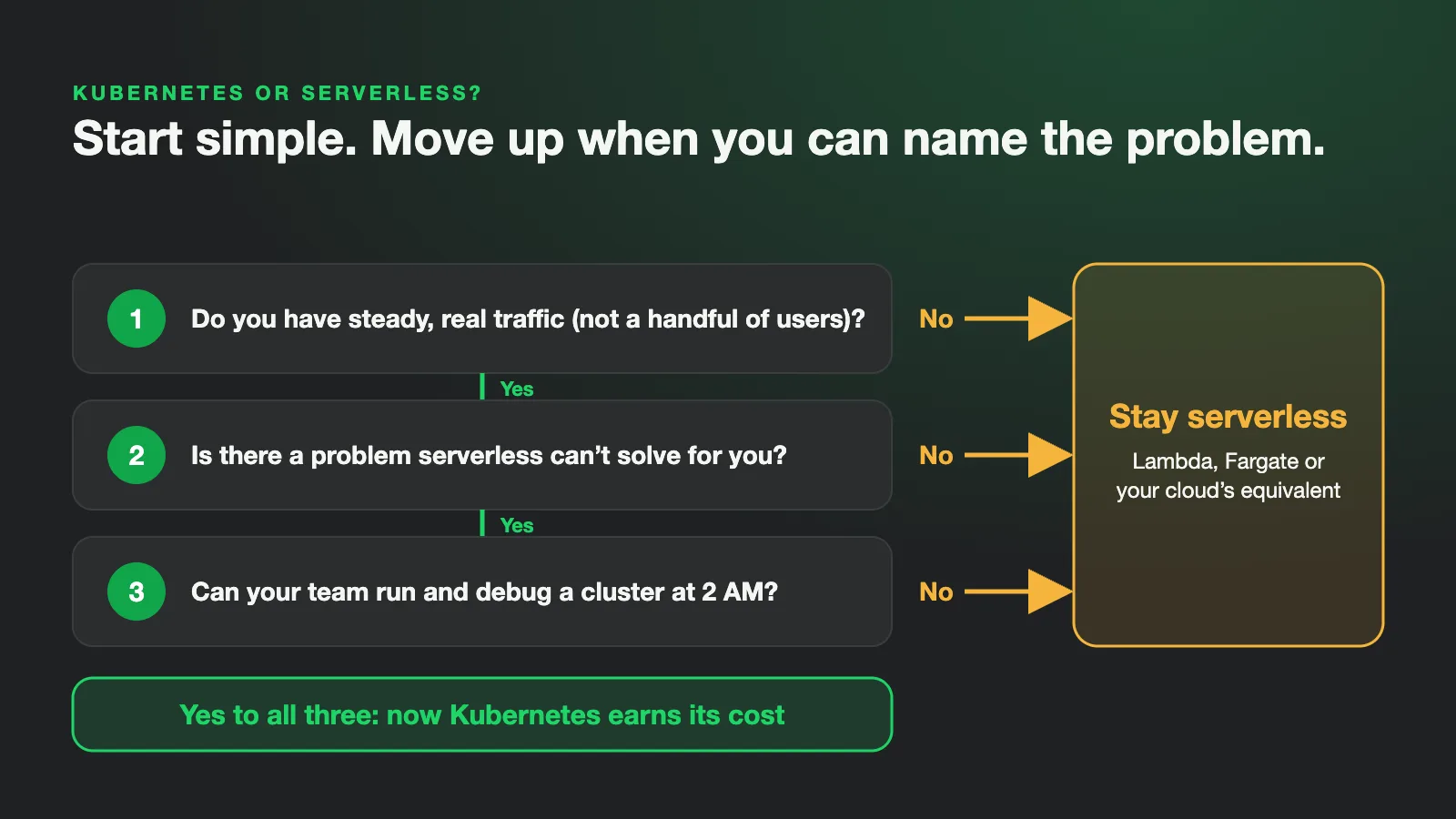
This is the most expensive mistake on the list, and it comes from a genuine confusion: people equate reliability with running ECS or EKS. They think Kubernetes is what makes a system reliable.
It is not. Kubernetes is what makes a large, complex system manageable. With a handful of customers, it gives you the complexity of a large system without the traffic that justifies it, and you pay for it twice, because on top of the machines you also pay for the control plane that runs the cluster.
Our SRE team's rule is simple: if you have very few customers, do not start with a full-time cluster. Start serverless (Lambda, Fargate, or whatever your cloud offers) and let the platform handle the scaling. Move to containers and orchestration when your traffic and your team are big enough to justify running them, not before.
If you want a second opinion on your current setup, our DevOps & SRE services start with exactly this question: what does your traffic actually need?
6. Paying for always-on servers instead of serverless
This is the cost version of the same mistake. A new team spins up EC2 instances that run 24 hours a day for traffic that arrives in bursts (a few users in the morning, almost none at night) and pays for every idle hour in between.
For a startup with very few customers, that machine mostly sits idle, and the bill arrives every month regardless. Serverless flips the math: you pay for what you use, and nothing when nobody is using it.
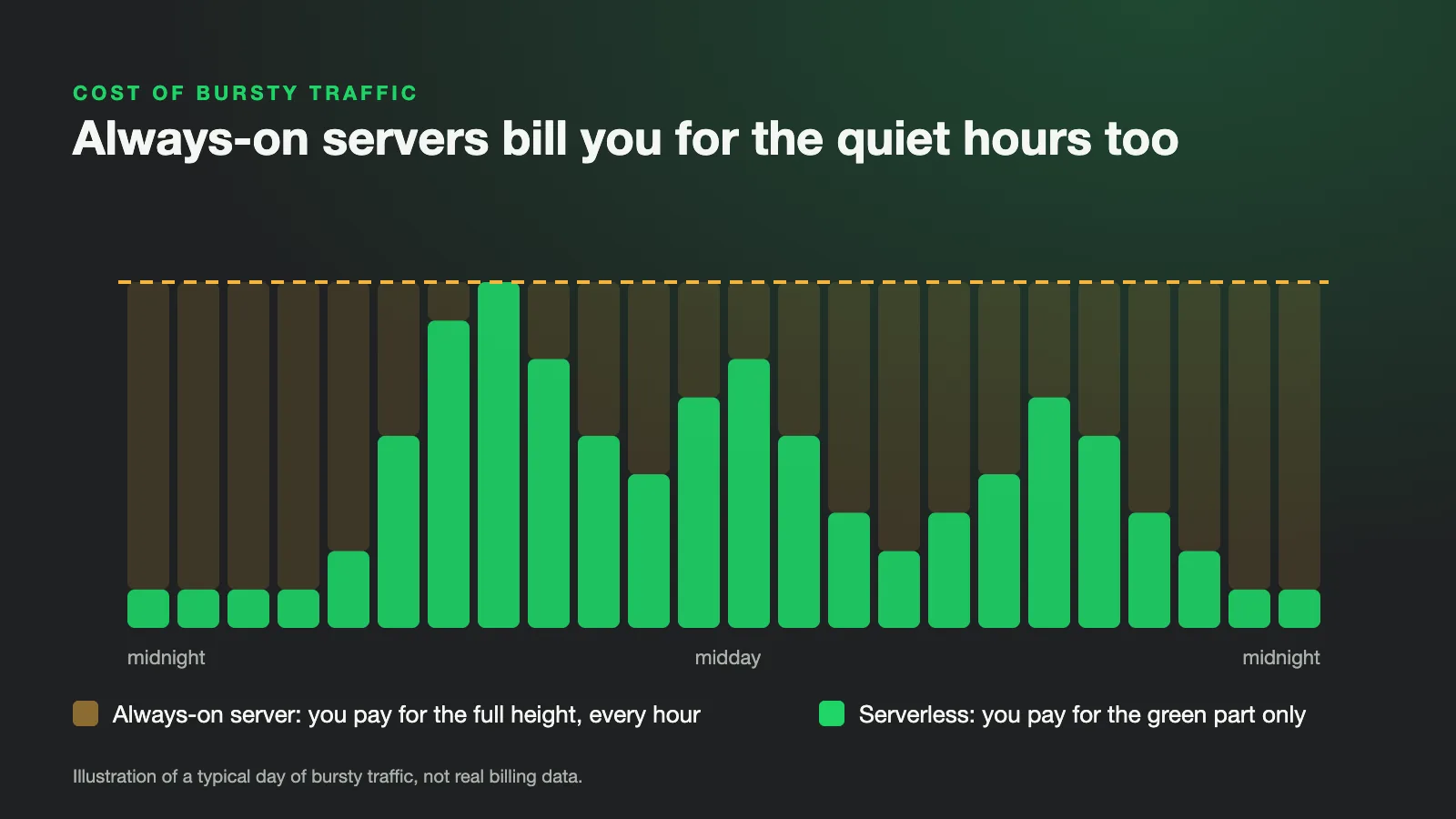
And this is where FinOps earns its keep. Cloud cost optimization is not a finance exercise; it is a reliability practice. If you do not know what each service costs, you cannot tell waste from real load, and you cannot tell whether the bill is growing because the product is growing or because something is leaking. Tag your resources, look at the bill every month, and kill the idle spend before it quietly becomes your biggest fixed cost.
7. Not knowing your MTTD
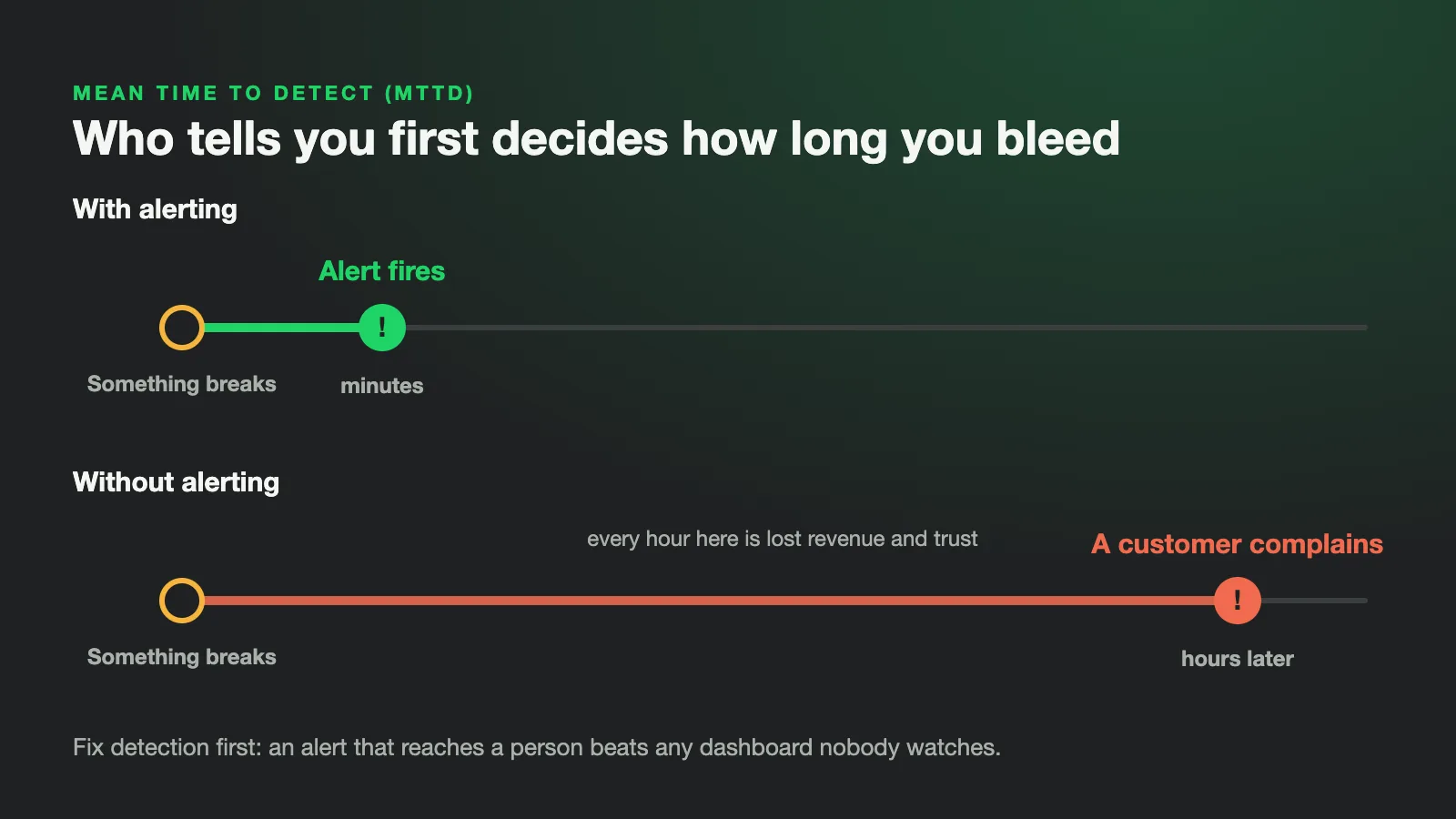
MTTD (mean time to detect) is the most honest reliability metric a startup has. It answers one question: when something breaks, how long does it take before you know?
If the answer is "a customer told us," your MTTD is measured in hours, and every one of those hours is damage. If the answer is "our alert fired in two minutes," you have a reliability practice, even if your setup is small.
of IT leaders still learn about service interruptions from customer complaints, tickets or manual checks
Source: New Relic Observability Forecast, 2025average time to detect an outage for teams with full-stack observability
Source: New Relic Observability Forecast, 2025When our SRE team takes over a new client's production, the first 30 days are spent looking at exactly three things: inefficiencies in the architecture's data flow, cost management, and MTTD. Data flow tells you where the system can break. Cost tells you where you are paying for nothing. MTTD tells you how long you will bleed before anyone notices. Fix detection first: everything else gets easier once you can see.
Your first-30-days reliability checklist
If you are an early-stage startup, this is the order our team would do it in:
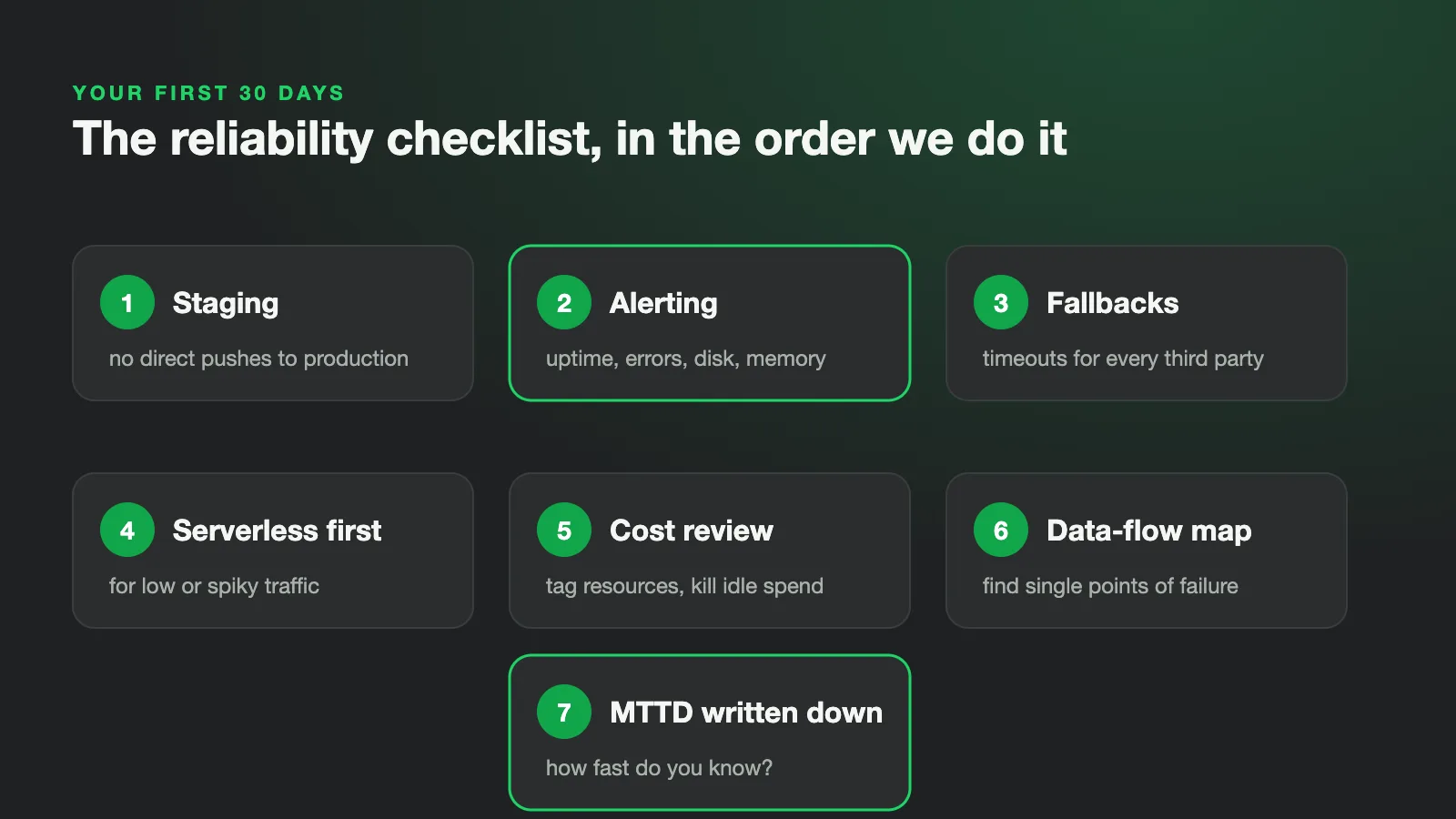
- Separate staging environment: nothing goes straight to production
- Alerting on uptime, error rate, and disk/memory, before any dashboards
- Timeouts and a fallback for every third-party service you depend on
- Serverless-first for low or spiky traffic; revisit when traffic grows
- Cloud cost review (FinOps basics): know what each service costs, kill the idle spend
- A map of your data flow end to end, and the single points of failure in it
- Your MTTD written down: how fast do you know, before your customers do?
None of this needs a big team or a big budget. It needs someone to decide that reliability is a habit, not a purchase, and to start before the first big outage, not after it.
Conclusion
Reliability is not something you buy when you get big. It is a set of small habits (alerting before dashboards, staging before production, serverless before clusters, detection before everything) that cost almost nothing at the start and save you when it matters.
If you want our SRE team to look at your setup and tell you where the gaps are, see our DevOps & SRE services.
Related reading: 10 Mobile App Development Mistakes Startups Make in 2026